
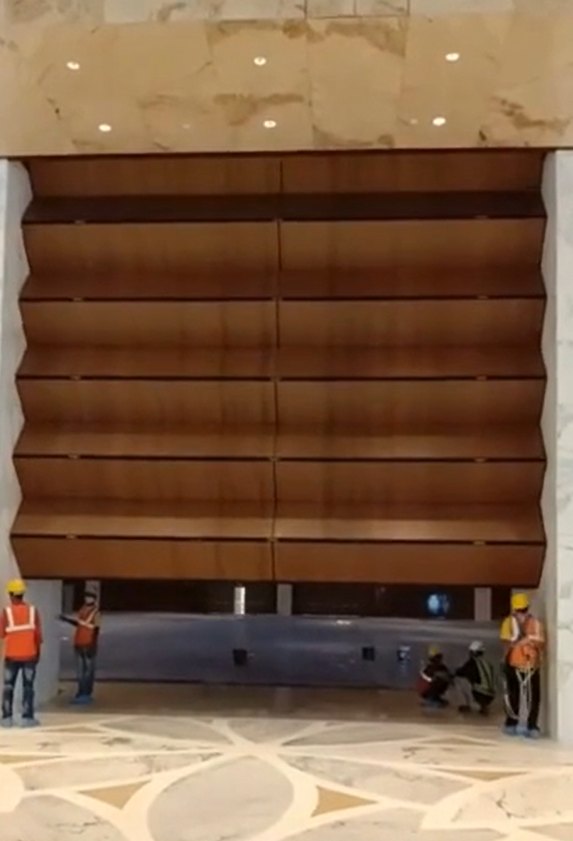
Vertical or horizontal?
A Skyfold wall descends from the ceiling at the touch of a button: no floor tracks, no wall pockets and no stacking space lost. A Variflex horizontal wall slides on an overhead track and stacks at the end of its run, which is often the better fit when the ceiling void or structure cannot carry a retractable system.
Series data
| Series | Max. height | Max. width | Sound reduction index |
|---|---|---|---|
| Skyfold Zenith | 3660 mm | 14,600 mm | 47–59 dB |
| Skyfold Classic | 11,000 mm | Unlimited | 51–59 dB |
| Skyfold Mirage (glazed) | 7310 mm | Unlimited | 34 dB |
| Variflex 88 / ML 88 / EI 30 | 14,000 mm | Panel width up to 1250 mm | Up to 58 dB |
Skyfold Mirage takes clear laminated glass, plexiglass, Lexan, bullet-proof glass or frosted glass inserts where daylight has to pass through the division.
How to brief us
- Division length and finished ceiling height, plus the available ceiling void.
- The acoustic separation you actually need between the two rooms.
- Whether the division must be glazed or opaque.
- Operation: fully automatic, semi-automatic or manual (Variflex covers all three).
- Finish: vinyl, fabric, wood veneer, specialty metals, laminates or marking surfaces.
Frequently asked
- How much sound does an operable wall block?
- Skyfold systems in our catalogue carry a sound reduction index of up to 59 dB (Zenith 47–59 dB, Classic 51–59 dB), the glazed Mirage series 34 dB, and Variflex horizontal walls up to 58 dB.
- Does a Skyfold wall need floor tracks or a storage pocket?
- No. It is vertically retractable and stores in the ceiling, so there are no floor tracks and no wall storage pockets, and system length is unlimited.
- How tall can an operable wall be?
- Skyfold Classic reaches a maximum system height of 11,000 mm and Variflex reaches system heights up to 14,000 mm.