
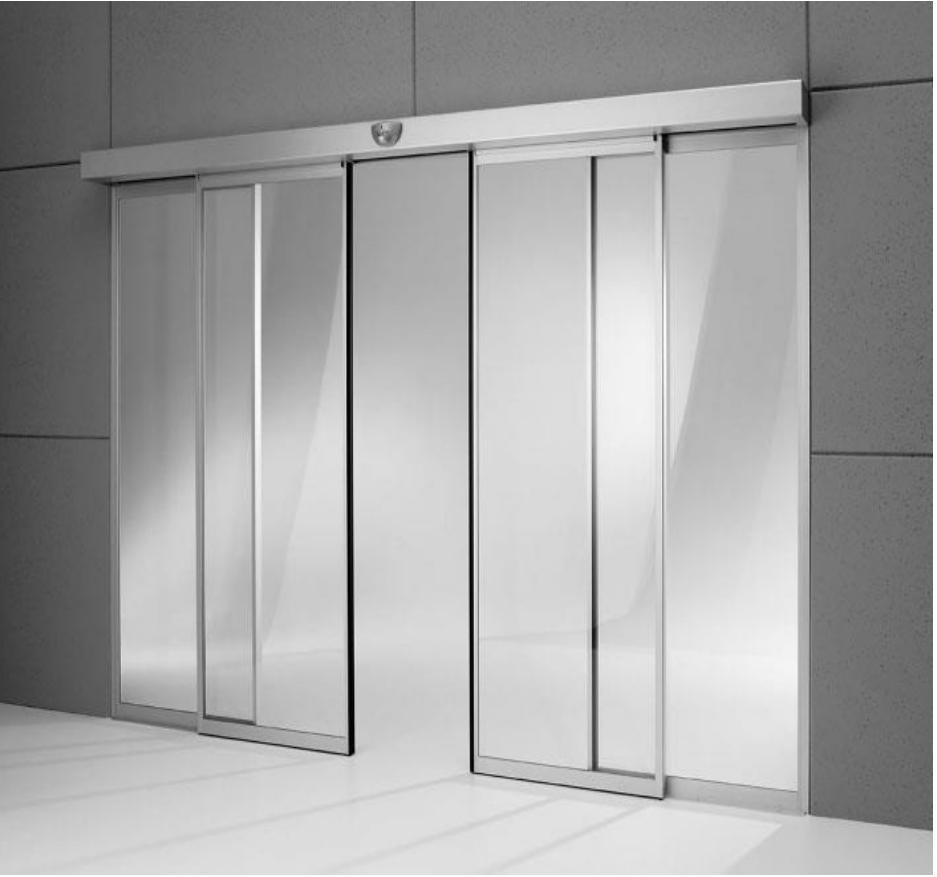
Start with the opening, not the product
Three numbers settle most entrance decisions: the structural opening available, the clear passage width the building needs at peak, and the leaf weight the architecture implies. Once those are fixed, the system family follows almost automatically.
- Narrow wall span but a wide clear passage needed → telescopic sliding (TST / FTST).
- Opening doubles as an escape route → sliding with emergency breakout (SST) or a swing operator approved for evacuation routes.
- Curved façade or a signature lobby → curved sliding (BST / F-BST), clear passage 1000–2500 mm.
- Air-conditioned lobby with heavy footfall → revolving entrance for continuous climate separation.
- Existing timber or glass leaf to automate → CS 80 MAGNEO, leaf weight 20–80 kg.
System comparison
| System | Best for | Key limits from the system data |
|---|---|---|
| Automatic sliding (ES 200 family) | Retail, airports, healthcare, hotels | ES 200 Easy / ES 200 / ES 200-2D operators; breakout versions approved for emergency exits per DIN 18650 / EN 16005 |
| Telescopic sliding (TST / FTST) | Wide passage in a narrow wall span | Same ES 200 operator family, telescopic leaves |
| Curved sliding (BST / F-BST) | Signature lobbies, curved façades | Clear passage 1000–2500 mm, fine-frame full-glass look |
| CS 80 MAGNEO | Interior glass or wooden doors, low-energy use | Leaf 20–80 kg, speed 0.2–0.6 m/s, openings 875 / 1000 / 1125 mm, tested to 1 million cycles |
| Swing operators (ED 100 / ED 250) | Existing swing leaves, barrier-free access | ED 100 up to 100 kg / 1100 mm leaf; ED 250 for heavier and wider leaves |
| Revolving entrances | Climate separation, premium lobbies | Continuous separation of inside and outside air; handicap button for temporary speed reduction on Talos RDR |
Then check the three things buyers forget
- Escape-route duty: if the leaf sits on an evacuation path, the system must be an approved emergency-exit variant — not a standard operator.
- Activation: radar, push pad or access control changes the wiring and the interface with the building's access system.
- Service access: an automatic entrance is a moving machine. Confirm who commissions it and who returns for maintenance before you buy it.
Alumina Engineering specifies, supplies, installs, commissions and maintains all of the above systems with one team, so the answers to those three questions come from a single accountable partner.
Frequently asked
- Which automatic door is best for a shopping mall entrance?
- High-footfall retail entrances are usually automatic sliding doors from the ES 200 family, because they give a wide clear passage with no swing arc. Where the entrance is also an escape route, the SST breakout variant is used so the full door width opens for through passage.
- Can an existing manual door be made automatic?
- Yes. ED 100 and ED 250 swing operators automate existing swing leaves (ED 100 up to 100 kg and 1100 mm leaf width), and CS 80 MAGNEO automates glass or wooden sliding leaves from 20 to 80 kg.
- Do automatic doors work during a power failure or fire?
- Emergency-exit approved variants are designed for escape-route duty per DIN 18650 / EN 16005, and swing operators are available for fire-proof and smoke-proof doors. The exact behaviour is set during commissioning, which is why the escape-route requirement must be declared at the specification stage.