
The two documents that matter
Our accessible door solutions follow the National Building Code Volume 1-2016, Part 3 – Annexure B and the CPWD Handbook on Barrier Free and Accessibility, Chapter 8. Together they cover the accessible route, door operation and the accessible restroom.
What an accessible door needs
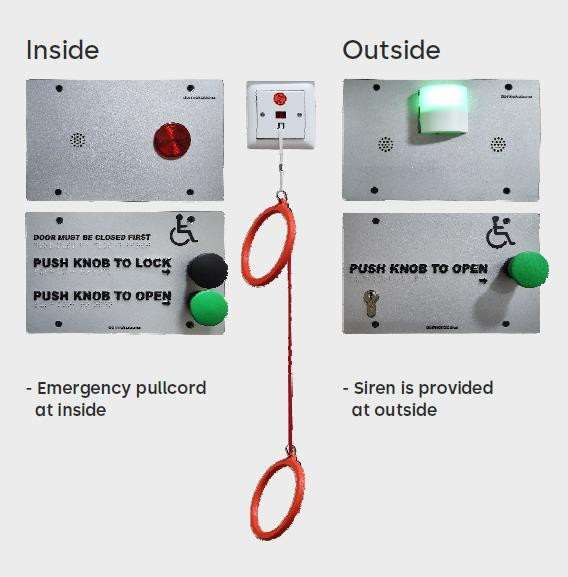
- An accessible layout with a push-knob lock and release at reachable height.
- An emergency pull-cord inside the restroom, with a siren outside.
- Operation that needs little force — low-energy automatic operators remove it entirely.
- Activation the user can actually reach: push pad, radar or access control.
The hardware we use to comply
| Requirement | System | Data |
|---|---|---|
| Effortless sliding door | CS 80 MAGNEO | Low-energy operator, adjustable speed 0.2–0.6 m/s, leaf 20–80 kg |
| Effortless swing door | ED 100 / ED 250 | Low Energy as default; push pad, radar or access control activation |
| Accessible revolving entrance | Talos RDR | Handicap button for temporary speed reduction; night-time closure with sliding wings |
Because these are the same product families used for the building's main entrances, accessibility can be achieved without a visually separate 'special' door.
Frequently asked
- Which code governs accessible doors in India?
- The National Building Code of India Volume 1-2016, Part 3 – Annexure B, read with the CPWD Handbook on Barrier Free and Accessibility, Chapter 8. Our accessible restroom door is built to both.
- How do you make a revolving door wheelchair friendly?
- Talos RDR revolving doors include a handicap button that temporarily reduces the rotation speed, so a wheelchair user or a person with a walking aid can pass comfortably.
- What does an accessible restroom door include?
- A reachable push-knob lock and release, an emergency pull-cord inside with a siren outside, and a layout compliant with NBC Volume 1-2016, Part 3 – Annexure B and CPWD Chapter 8.